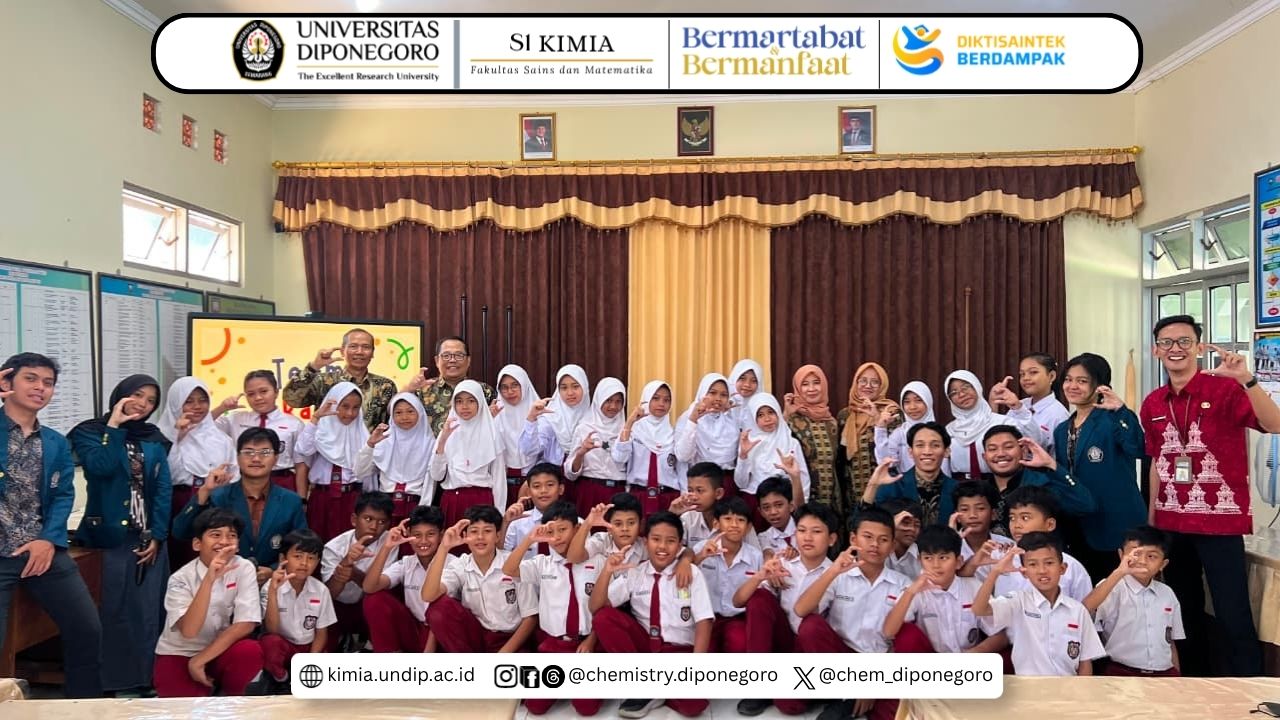
Semarang, July 23, 2026 — The Community Service Team from the Department of Chemistry, Faculty of Science and Mathematics (FSM), Universitas Diponegoro (UNDIP), conducted an educational outreach program entitled “Education on Nutritious Food and Effective Study Strategies for Students of SDN Kalirejo 02, East Ungaran, Semarang Regency.” The activity was held at SDN Kalirejo 02, located approximately 16 kilometers from UNDIP’s Tembalang Campus and accessible within 15–20 minutes via the toll road.
The community service team consisted of five lecturers—Pardoyo, Suhartana, Sriyanti, Mukhammad Asy’ari, and Damar Nurwahyu Bima—and was supported by six students from the UNDIP Department of Chemistry: Christofer Rafael Valerian Tarigan, Rizky Cendikia, Izaaz Bariq Fajar, Sulthan Muhammad Rizky, Indah Latipah, and Hana Fakhirah.

The program targeted sixth-grade students of SDN Kalirejo 02, who are preparing for examinations and academic competency tests. A total of 36 students participated enthusiastically in the educational session, accompanied by teachers and school representatives. Through the program, the team aimed to provide students with practical knowledge and motivation to maintain healthy lifestyles while improving their learning performance as they continue to the next level of education.
Promoting Healthy Nutrition for Better Learning
The head of the community service team, Pardoyo, explained that the topic was selected because nutritional issues among school-age children in Indonesia continue to require serious attention. Although the national stunting prevalence has declined from 21.6 percent in 2023 to 18.8 percent in 2025, nutritional challenges among children remain an important concern.
“Chemistry lecturers and students have great potential to serve as educational agents. They can not only share knowledge about nutrition but also introduce effective learning strategies to help children prepare themselves for future educational challenges,” Pardoyo said.
The team emphasized that inadequate nutrition can directly affect students’ learning motivation and cognitive performance. Poor nutritional intake may interfere with brain function, causing children to become easily tired or sleepy, experience difficulty concentrating, and have reduced ability to absorb information.
At the same time, ineffective study habits—such as studying intensively only the night before an examination—can increase stress and negatively affect academic performance. These two interconnected issues became the foundation for developing the educational materials presented during the program.
Interactive Learning Through Nutrition and Study Techniques
The educational activities were delivered interactively using educational pamphlets, presentation materials, and videos designed specifically to be easily understood by elementary school students.
The nutrition session introduced students to four major groups of nutrients. Students learned about energy-providing nutrients, including carbohydrates and healthy fats; body-building nutrients, particularly animal- and plant-based proteins; regulatory nutrients, including vitamins and minerals; and dietary fiber, which plays an important role in maintaining digestive health.
In addition to nutrition education, the students were introduced to several effective learning strategies. One of the techniques presented was the Pomodoro Technique, which divides study time into 25-minute intervals followed by short breaks. The students were also introduced to active recall and spaced repetition, two learning strategies that can help strengthen memory and improve long-term retention of information.
The students enthusiastically participated in a practical simulation of the Pomodoro Technique, which was guided directly by members of the community service team.
One of the sixth-grade students, Fandi, said that the program gave him new insights into the relationship between nutrition and learning.
“I learned for the first time that eating unhealthy snacks can make it harder to concentrate while studying. Now I want to try studying for 25 minutes and then taking a break,” he said.
Positive Response from the School
The school principal and teachers welcomed the program and expressed their hope that similar educational activities could continue in the future. According to the school, presenting the material through interactive activities helped students understand and absorb the information more easily compared with conventional lecture-based approaches.
The activity also provided an opportunity for UNDIP lecturers and students to interact directly with elementary school students and share practical knowledge that can be applied in their daily lives.
Through this community service program, the Department of Chemistry, FSM UNDIP hopes to continue contributing to the healthy growth, development, and academic achievement of school-age children. The initiative also represents a concrete implementation of the Tri Dharma of Higher Education, particularly the university’s commitment to community service and the dissemination of academic knowledge for the benefit of society.