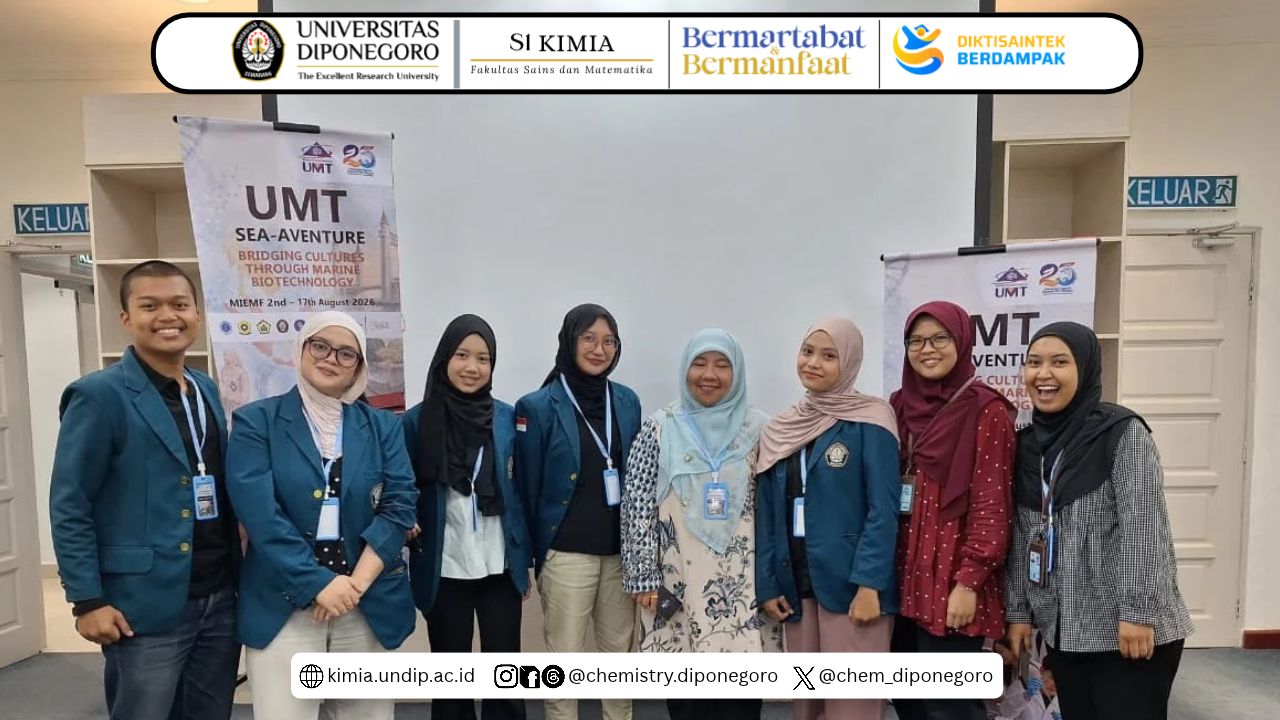
Terengganu, Malaysia — Students from Universitas Diponegoro (UNDIP) participated in the International Summer Course hosted by Universiti Malaysia Terengganu (UMT) from 2–17 August 2026. The program formed part of an international academic and research initiative that brought together students and academics from several higher education institutions in Indonesia and Malaysia to enhance academic perspectives, research experience, and international collaboration networks.
The International Summer Course was attended by students from several Indonesian universities, including Institut Pertanian Bogor (IPB), Institut Teknologi Bandung (ITB), Universitas Diponegoro (UNDIP), Universitas Sriwijaya (UNSRI), and Universitas Bengkulu (UNIB). The program focused on the exploration, study, and utilization of natural resources, particularly plant-based natural products, through an integrated series of academic activities, research projects, fieldwork, laboratory practice, and cultural exchange.
Throughout the program, participants had the opportunity to become familiar with UMT’s academic environment and research facilities. The activities included visits to the ICAMB (Institute of Marine Biotechnology) laboratory facilities, the INOS research gallery, the Akuatrop hatchery laboratory, as well as fisheries and food science laboratories. These visits provided participants with insights into various research areas developed at UMT, particularly those related to natural resource utilization, biotechnology, fisheries, food science, and coastal environmental studies.
In addition to academic activities and laboratory visits, participants conducted fieldwork at Setiu Wetland and Bukit Kor, Terengganu. The field activities provided direct learning experiences related to coastal and wetland ecosystems while introducing participants to field observation and plant sampling techniques. The collected plant samples were subsequently utilized as research materials in laboratory activities.
One of the main components of the program was a natural products research project conducted at the Makmal Produk Semula Jadi Marin, ICAMB-UMT. Participants gained hands-on experience in several stages of natural products research, including drying and grinding leaf samples, methanolic extraction, concentration of extracts using a rotary evaporator, and compound profiling through Thin Layer Chromatography (TLC).
The research activities were subsequently continued through antioxidant activity assays using the DPPH and FeCl₃ methods. Participants were divided into several groups and assigned different plant samples. This arrangement enabled each group to complete the research process systematically, beginning with sample preparation and extraction, followed by analytical procedures, observation, and interpretation of the results.
Beyond laboratory-based research, the International Summer Course also featured seminars, academic workshops involving academics and practitioners, inter-university discussions, and sharing sessions with UMT researchers. These activities provided an academic platform for participants to exchange knowledge and perspectives concerning research, natural resource utilization, and the potential development of natural products for various applications.
Cultural exchange was also an integral component of the program. Participants had the opportunity to explore the social and cultural environment of Terengganu through visits to Kuala Terengganu, introductions to traditional attire and the local language, and participation in traditional games. Interactions with students and academics from diverse backgrounds further enriched participants’ experiences in developing communication, collaboration, and intercultural understanding within an international academic environment.
Participation in the International Summer Course provided UNDIP students with practical academic and research experiences while broadening their understanding of the exploration and utilization of natural resources. In addition to strengthening laboratory and research skills, the program contributed to the development of scientific communication, teamwork, adaptability, and intercultural interaction.
Through participation in the International Summer Course, UNDIP continues to expand student engagement in international academic and research activities. The program serves as a platform for strengthening student competencies while fostering academic networks and collaboration among UNDIP, UMT, and partner universities in the areas of education, research, and sustainable natural resource development.