
UNDIP Global Classroom Explores the Principles of Spectrophotometry and Its Applications in Quantitative Analysis
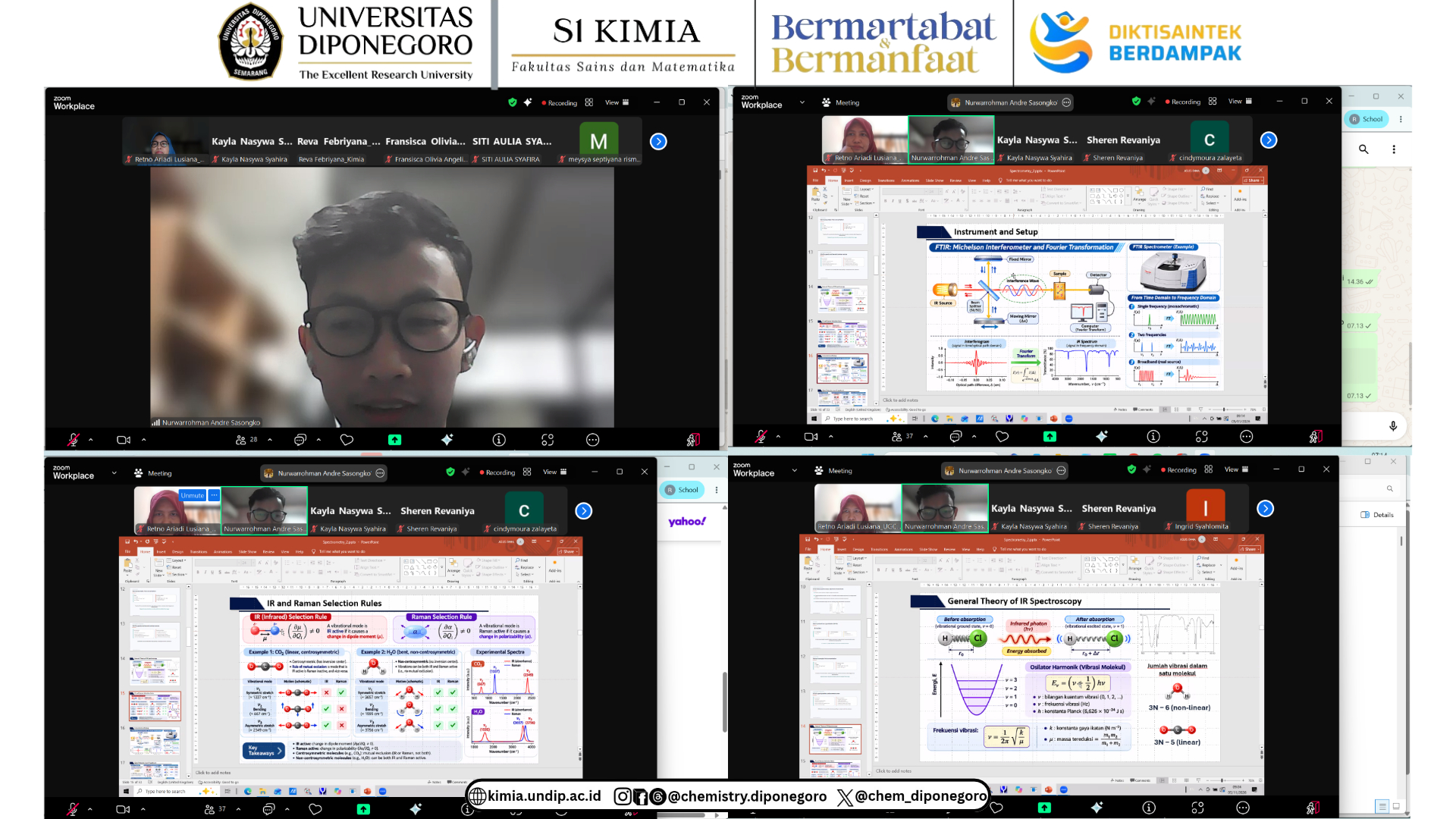
SEMARANG, INDONESIA – The Department of Chemistry, Faculty of Science and Mathematics (FSM), Universitas Diponegoro (UNDIP), successfully organized the Undip Global Classroom (UGC) program on October 29 and November 5, 2026. The international academic program focused on the Principles of Spectrophotometric Methods and Their Applications in Quantitative Testing.
The program provided an opportunity for UNDIP students to deepen their understanding of spectrophotometry. It also introduced students to advanced concepts in molecular spectroscopy and analytical instrumentation through an international academic perspective.
The sessions featured Nurwarohman Andre Sasongko, S.Si., M.Sc., Ph.D., from Pukyong National University, South Korea, as the speaker. Meanwhile, Dr. Retno Ariadi Lusiana, M.Si., served as the moderator.
Exploring the Fundamental Principles of Spectrophotometry
Spectrophotometry is an essential analytical technique in chemistry. It measures the interaction between electromagnetic radiation and matter. This technique plays a significant role in determining the concentration of chemical substances through their absorption or transmission of light.
During the UGC sessions, the speaker discussed the fundamental principles of spectrophotometric methods and their applications in quantitative analysis. The discussion covered the relationship between electromagnetic radiation, molecular structure, and the resulting spectral response.
Students also explored how different regions of the electromagnetic spectrum provide valuable information about chemical substances. These regions include ultraviolet (UV), visible, infrared (IR), X-ray, and gamma radiation.
Each spectral region has distinct characteristics and applications. Understanding these differences helps students select suitable analytical techniques for various chemical investigations.
Understanding IR Theory and Raman Spectroscopy
One of the key topics was the general theory of infrared (IR) spectroscopy. The session explained how molecules absorb infrared radiation and undergo vibrational transitions.
The discussion also covered the IR and Raman selection rules. These principles determine whether molecular vibrations can be observed through infrared absorption or Raman scattering.
Students learned that IR spectroscopy depends on changes in the molecular dipole moment. In contrast, Raman spectroscopy relies on changes in molecular polarizability.
This comparison provided a deeper understanding of the complementary nature of IR and Raman spectroscopy. Both techniques are widely used to identify molecular structures and characterize chemical compounds.
The speaker also explained the instrumental setup of IR and Raman spectroscopy. The discussion introduced the essential components of spectroscopic instruments and their roles in obtaining reliable analytical data.
Exploring the Electromagnetic Spectrum and Analytical Instrumentation
The program further examined the broader electromagnetic spectrum, from ultraviolet and visible radiation to X-rays and gamma rays.
Each type of radiation interacts with matter in a different way. These interactions form the basis of various spectroscopic techniques used in chemistry and related scientific fields.
The discussion highlighted the importance of understanding radiation properties, energy transitions, and instrument configurations. These concepts are essential for selecting appropriate analytical methods and interpreting experimental results.
Through this comprehensive discussion, students gained a broader perspective on the role of spectrophotometry and spectroscopy in modern chemical analysis.
Strengthening International Academic Collaboration
The Undip Global Classroom program is part of UNDIP’s commitment to strengthening international academic engagement and improving the quality of higher education.
By inviting an international speaker, the program provided students with access to global scientific perspectives. It also encouraged academic interaction and knowledge exchange between UNDIP students and international researchers.
The participation of students from Universitas Diponegoro demonstrated the importance of international learning opportunities in supporting academic development.
The program is expected to enhance students’ knowledge of analytical chemistry, spectroscopy, and instrumental analysis. It also supports the development of scientific competencies needed for future research and professional careers.
Through Undip Global Classroom, the Department of Chemistry FSM UNDIP continues to promote internationally oriented education, scientific excellence, and meaningful academic collaboration.
#KimiaUNDIP #FSMUNDIP #UniversitasDiponegoro #UndipGlobalClassroom #UGC #Spectrophotometry #Spectroscopy #AnalyticalChemistry #InternationalAcademicCollaboration