

Semarang, March 5 and 12, 2026 – The Undergraduate Chemistry Study Program, Faculty of Science and Mathematics (FSM), Universitas Diponegoro (UNDIP), once again demonstrated its commitment to academic internationalization through the implementation of the Undip Global Classroom (UGC) program. Conducted online on March 5 and 12, 2026, the program was integrated into the Chemical Speciation course attended by undergraduate chemistry students of FSM UNDIP.
The program featured Dr. rer. nat. Wisnu Arfian Anditya Sudjarwo, S.Si., M.Si., a Postdoctoral Researcher and Deputy Head at the Institute of Biophysics, BOKU University, Vienna, Austria, as the guest lecturer. The two online sessions were held via Zoom from 10:40 a.m. to 12:20 p.m. (WIB). Dr. Wisnu is an alumnus of Universitas Diponegoro (B.Sc.) and Universitas Gadjah Mada (M.Sc.), and a recipient of the prestigious Ernst Mach Grant from OeAD Austria for his doctoral studies at the University of Vienna. His research experience includes collaborations with the Max Planck Institute (Germany) and several institutions in Indonesia.
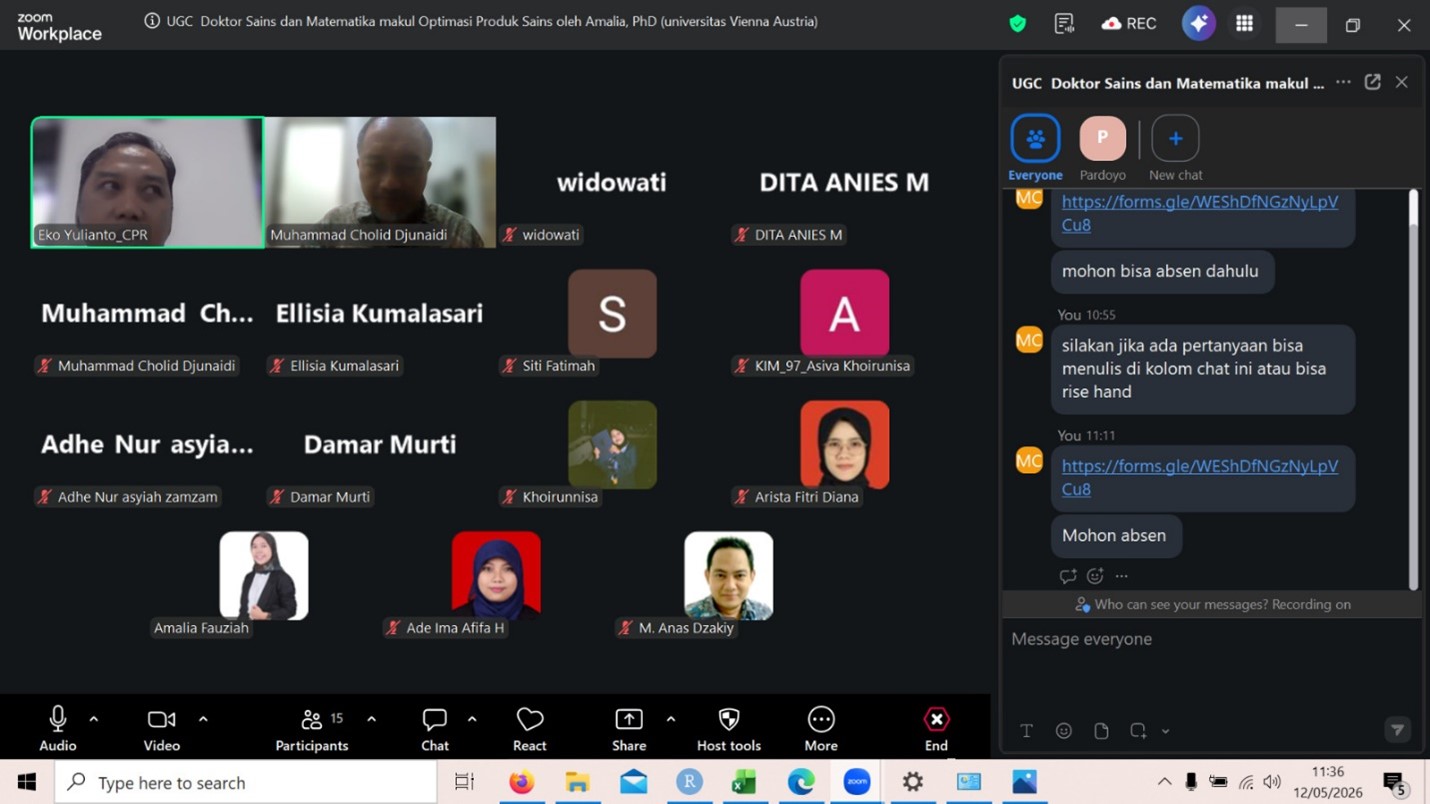
During the first session on March 5, 2026, Dr. Wisnu delivered a lecture entitled “Chemical Speciation and Toxicity: Exploring How Chemical Forms Determine Toxicity.” Referring to the IUPAC definition, chemical speciation was introduced as the distribution of an element among defined chemical species within a system, including isotopic composition, oxidation state, and molecular or complex structures.
The lecture emphasized that the bioavailability and toxicity of metals are not determined solely by their total concentration but largely by their specific chemical forms. Examples discussed included differences in toxicity among oxidation states such as Cr(III) versus Cr(VI), Hg⁰ versus Hg(II), and As(III) versus As(V). The session also highlighted the role of organometallic compounds, whose lipophilic properties enable them to penetrate biological membranes more easily, thereby influencing toxicity.
Another key topic was the role of Dissolved Natural Organic Matter (DNOM), including humic and fulvic acids, which function as natural chelating agents capable of binding metal ions. Participants were also introduced to Paracelsus’ famous toxicological principle, “The dose makes the poison,” emphasizing that toxicity depends on the amount of exposure rather than the mere presence of a substance.
Furthermore, Dr. Wisnu explained the Free Ion Activity Model (FIAM), which proposes that metal toxicity to aquatic organisms is more closely related to the activity of free, uncomplexed metal ions than to total metal concentrations in solution. Factors influencing chemical speciation, including pH, redox conditions, and microbial activities, were also discussed. Several bacteria, such as Pseudomonas aeruginosa, Bacillus subtilis, and Microbacterium arborescens, were highlighted for their ability to reduce the highly toxic Cr(VI) species into the less toxic Cr(III) form.
To conclude the session, students participated in an interactive quiz using Mentimeter to assess their understanding of the concepts discussed in real time.
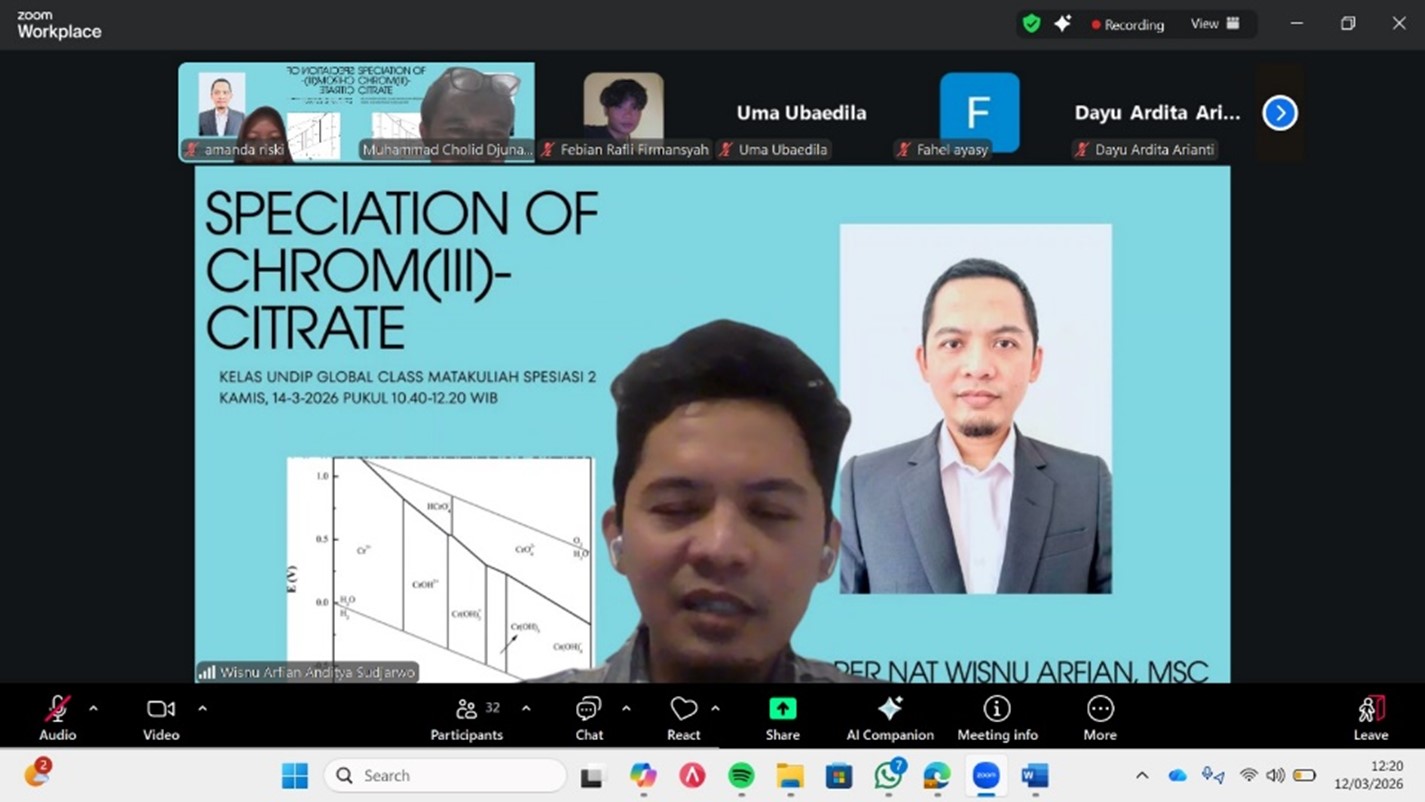
The second session, held on March 12, 2026, focused on the topic “Speciation of Cr(III)-Citrate System in the Leachate Samples of Phosphate Ore.” The lecture presented an in-depth case study based on the research article by Khelalfa and Delimi (2024) published in Desalination and Water Treatment (317:100109).
In this study, citric acid was employed as a leaching agent due to its ability to form highly stable and soluble complexes with Cr(III), namely CrH₃Cit³⁺, CrH₂Cit²⁺, and CrHCit⁺, with stability constants (log β) of 19.01, 16.34, and 12.54, respectively. Its abundance, biodegradability, and environmentally friendly characteristics make citric acid an attractive alternative to conventional mineral acids.
The lecture also addressed the importance of using ion activities rather than concentrations in equilibrium calculations. Four activity correction models were introduced, including the Debye–Hückel equation for dilute solutions (<0.01 M), the Extended Debye–Hückel model (0.01–0.1 M), the Davies equation (<0.5 M), and the Pitzer model (>1 M). By combining mass balance and equilibrium equations, the distribution of Cr(III) species was calculated as a function of citric acid concentration ranging from 10⁻⁴ to 10⁻¹ mol/L, revealing that the CrH₂Cit²⁺ complex becomes the dominant species at higher citric acid concentrations.
Experimental techniques commonly used in speciation studies, including potentiometric titration, spectrophotometric titration, and calorimetric titration, were also introduced. Similar to the first session, the lecture concluded with an interactive Mentimeter quiz designed to evaluate students’ understanding of equilibrium constants, ion activity models, and Cr(III)-citrate species distribution.
The UGC format, which integrated two class meetings into an international learning experience, successfully facilitated meaningful academic interactions between students and an internationally recognized researcher. The use of Mentimeter in both sessions encouraged active participation and enabled immediate assessment of student comprehension.
Students showed strong enthusiasm throughout the program, engaging in discussions on the application of chemical speciation in environmental sample analysis, metal toxicology in biological systems, and the role of computational approaches in predicting chemical species distribution under real environmental conditions.
Through the Undip Global Classroom initiative, Universitas Diponegoro continues to strengthen its international academic network, enhance research-based learning, and foster the scientific capacity of both students and faculty members. The program is expected to contribute to the development of highly competent, analytical, and globally competitive chemistry graduates who are prepared to address challenges in environmental chemistry and sustainable environmental management.