
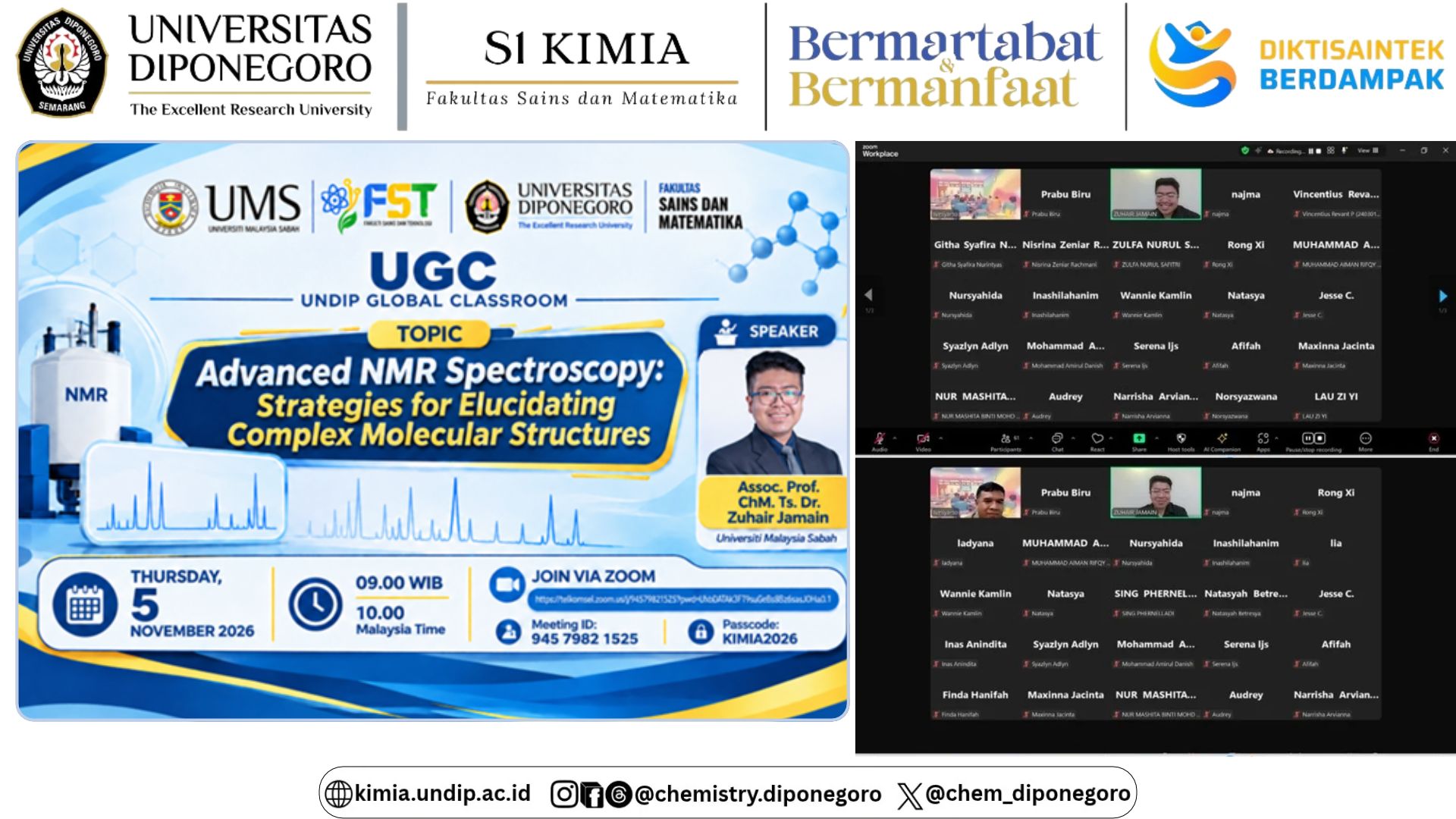
UNDIP Global Classroom Explores Advanced NMR Spectroscopy for Complex Molecular Structure Elucidation
SEMARANG – The Department of Chemistry, Faculty of Science and Mathematics (FSM), Universitas Diponegoro (UNDIP), held another UNDIP Global Classroom (UGC) on Thursday, November 5, 2026. The event featured the topic “Advanced NMR Spectroscopy: Strategies for Elucidating Complex Molecular Structures.”
The online session took place via Zoom Meeting. It brought together members of the academic community and participants interested in spectroscopy and structural chemistry.
Exploring Advanced NMR Spectroscopy
The session featured Associate Professor ChM. Ts. Dr. Zuhair Jamain from Universiti Malaysia Sabah as the speaker. He introduced advanced Nuclear Magnetic Resonance (NMR) spectroscopy and discussed strategies for elucidating complex molecular structures.
The discussion highlighted the importance of advanced NMR techniques in chemical research. These techniques provide valuable spectral information for identifying compounds and determining their molecular structures.
Participants also gained insights into how NMR spectroscopy supports the analysis of complex chemical compounds. This knowledge is particularly relevant to researchers working in structural chemistry and molecular identification.
Strengthening International Academic Collaboration
Prof. Dr. Meiny Suzery, M.S. from Universitas Diponegoro served as the moderator. She guided the academic discussion and encouraged knowledge exchange between the speaker and participants.
The discussion was expected to broaden participants’ understanding of advanced NMR spectroscopy. It also provided an opportunity to exchange research knowledge and experience between Universitas Diponegoro and Universiti Malaysia Sabah.
Through the UNDIP Global Classroom program, the Department of Chemistry FSM UNDIP continues to promote internationalization in higher education. The initiative also strengthens academic networks with international partner institutions.
Furthermore, this program supports globally oriented learning and provides access to developments in advanced chemical analysis techniques. These efforts are expected to contribute to future research, scientific publications, and cross-institutional collaborations.