Transforming shallot waste into high-quality raw material through natural products chemistry and process standardization
Brebes, August 7, 2026 – The Chemistry Study Program, Faculty of Science and Mathematics (FSM), Universitas Diponegoro (UNDIP), conducted an International Community Service Program in Brebes Regency, focusing on the potential of shallot peels as a value-added raw material.
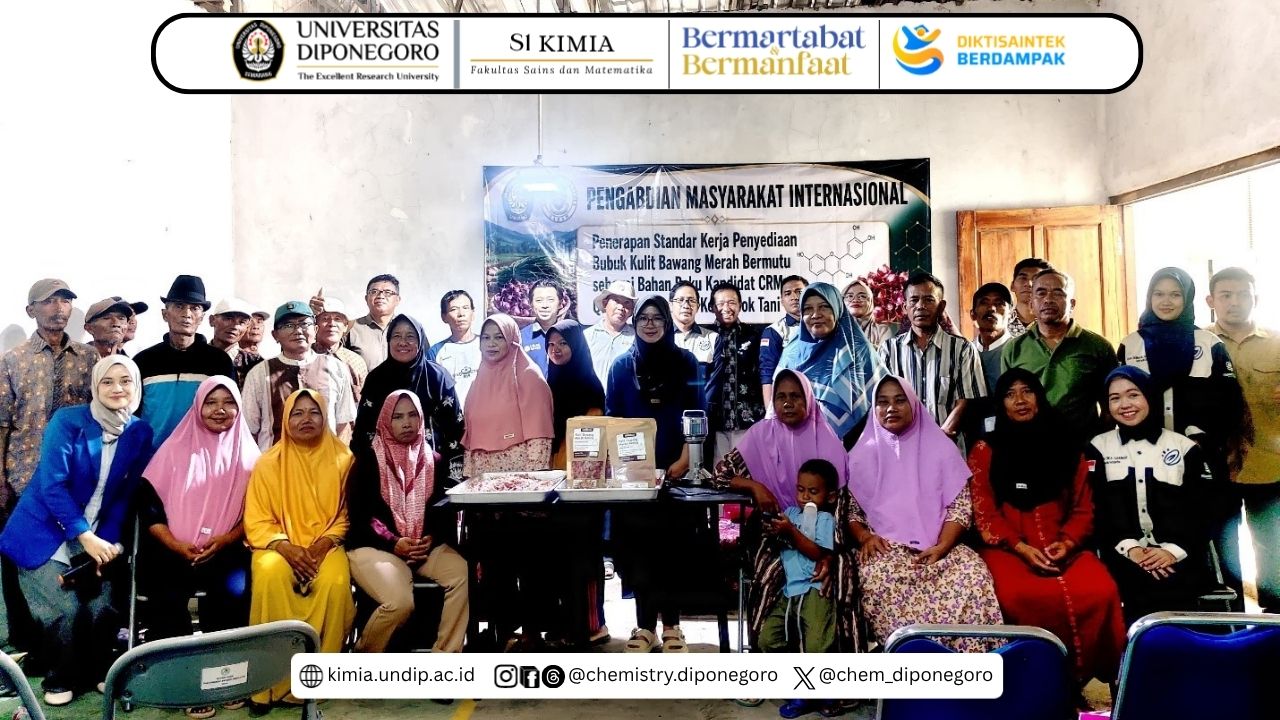
The activity, entitled “Implementation of Work Standards for the Provision of High-Quality Shallot Peel Powder as Raw Material for Quercetin CRM Candidates Based on Farmer Groups,” was part of the SDGs International Community Service Program, under the theme “Application of Natural Products Organic Chemistry and Biochemistry,” within the 2026 World Class University (WCU) Program of the Faculty of Science and Mathematics, UNDIP. The program was conducted both offline at FSM UNDIP and in Brebes Regency from August 5–7, 2026.
Shallot Peels as a Value-Added Natural Resource
Brebes Regency is widely known as one of Indonesia’s major shallot-producing regions. Alongside the high level of shallot production, shallot peels remain one of the agricultural by-products that have not yet been utilized optimally.
Through a natural products organic chemistry approach, shallot peels are being developed beyond their conventional status as waste into a value-added source of raw materials. One of the compounds of interest is quercetin, a flavonoid compound found in shallot peels.
This activity specifically focused on implementing work standards for the production of high-quality shallot peel powder as a raw material for the further development of a candidate Certified Reference Material (CRM) for quercetin.
This approach represents an effort to connect the expertise of higher education institutions in natural products chemistry with the potential of local resources within the community.
Involving 50 Farmer Group Members
The program involved approximately 50 members of farmer groups in Brebes Regency. Participants received guidance on the handling of shallot peel raw materials, drying techniques, quality control, as well as product packaging and storage.
The processing procedures were designed to produce materials with more consistent characteristics that could subsequently be used as raw materials for further research.
The mentoring activities resulted in a product called Kulit Bawang Merah Kering Brebesia (Dried Shallot Peel), carrying an identity associated with Brebes, Central Java. The product was developed for research, educational purposes, and as a natural coloring material, while also serving as an initial form of downstream development of shallot peels as a source of natural products.
Applying Quality Standards from Raw Materials to Final Products
One of the key aspects of the program was introducing the principle that the quality of natural-product materials is determined from the raw-material stage.
Participants were guided to understand the importance of selecting and handling shallot peels, applying appropriate drying processes, and ensuring proper packaging and storage. This approach is expected to improve the consistency and quality of materials produced by the farmer groups.
The program also included an evaluation of practical results and discussions on challenges encountered during the processing stages. Based on these evaluations, the Standard Operating Procedures (SOPs) for drying, packaging, and product storage were further refined.
Strengthening International Collaboration
The community service program also strengthened UNDIP’s international network through the involvement of Associate Professor Dr. Mohd Hafiz Abd. Majid from the Faculty of Science and Technology, Universiti Malaysia Sabah, as a resource person.
The materials presented covered product quality improvement, drying techniques, and food safety. The activity was also complemented by a demonstration of appropriate drying techniques to help maintain product quality.
This collaboration provided an international perspective on the application of standards for natural-material processing while strengthening the implementation of the WCU program through activities that deliver direct benefits to the community.
From Natural Products Chemistry Research to Downstream Application
The activity in Brebes demonstrates the role of the Chemistry Study Program in bringing academic knowledge and technological developments closer to the community.
The utilization of shallot peels as raw material for a candidate quercetin CRM brings together three important aspects: the potential of local commodities, expertise in natural products chemistry, and the need for standardized materials for research purposes.
Through this program, the UNDIP Chemistry Study Program encourages more productive utilization of local resources while strengthening a research and community service ecosystem oriented toward downstream application and community benefit.
The activity is also in line with UNDIP’s community service direction, which emphasizes the utilization of local culture and resources to produce outcomes that are practical, useful, and beneficial to society.