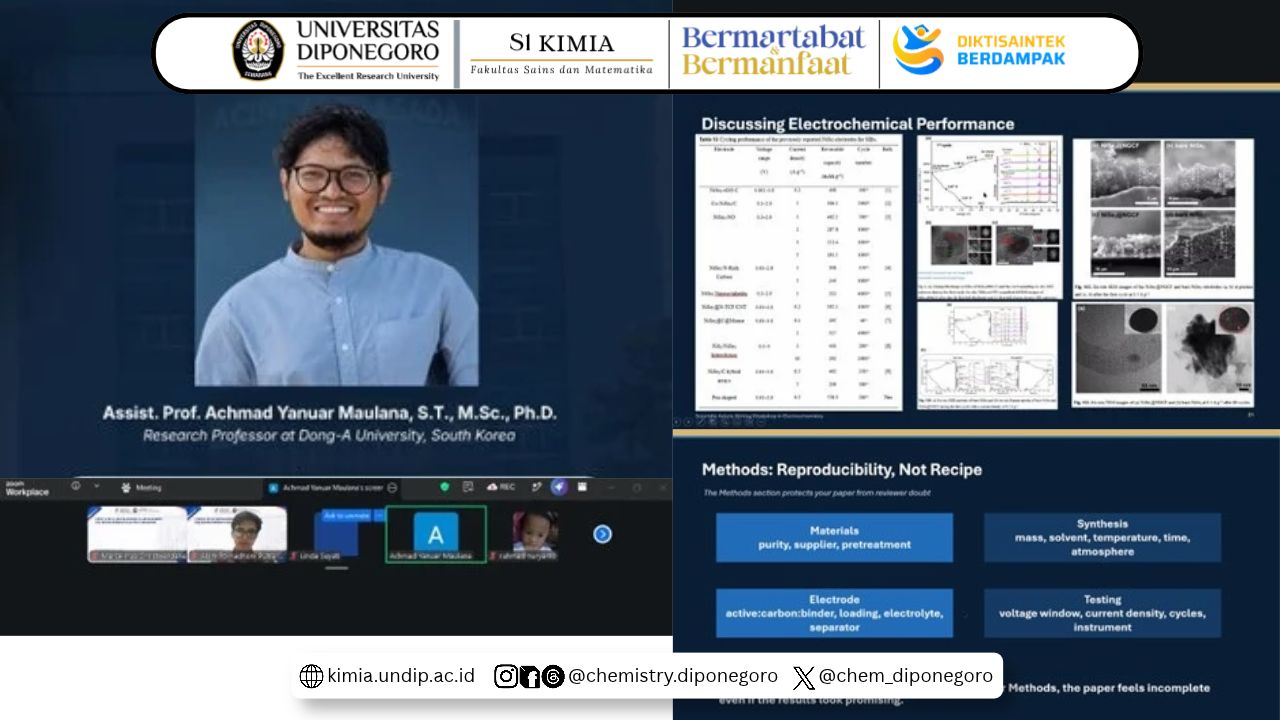
Semarang, August 6, 2026 — The Department of Chemistry, FSM UNDIP, through the Bioelectrochemistry Research Group and Electrochemistry Research Cluster, successfully organized a Scientific Article Writing Workshop featuring Assist. Prof. Achmad Yanuar Maulana, S.T., M.Sc., Ph.D. from Dong-A University, South Korea. The workshop focused on strengthening researchers’ skills in developing electrochemistry research findings into high-quality scientific articles for international publication. The Scientific Article Writing Workshop in Electrochemistry: From Research Findings to High-Impact Publications was successfully held online via Zoom. The workshop served as a platform for strengthening researchers’ capacity to transform their research findings in electrochemistry into high-quality scientific articles suitable for publication in reputable international journals.
The workshop was organized through a collaboration between the Bioelectrochemistry Research Group, Department of Chemistry, Faculty of Science and Mathematics, Universitas Diponegoro (UNDIP) and the Electrochemistry Research Cluster of FSM UNDIP, with financial support from the 2026 World Class University (WCU) Program of Universitas Diponegoro.
The event formed part of ongoing efforts to strengthen international research collaboration and improve the quality and impact of scientific publications produced by the Universitas Diponegoro academic community.
The workshop featured Assist. Prof. Achmad Yanuar Maulana, S.T., M.Sc., Ph.D., a Research Professor from Dong-A University, South Korea, as the keynote speaker. He delivered a comprehensive session on strategies for writing scientific articles in electrochemistry, covering the development of research ideas, manuscript preparation, presentation and interpretation of research findings, and approaches to improving article quality to meet the standards of reputable international journals.
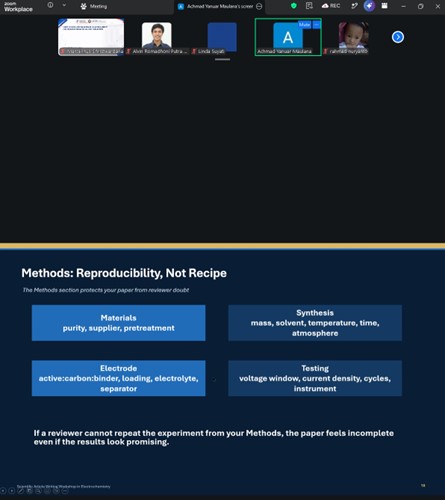
The session was moderated by Dr. Alvin Romadhoni Putra Hidayat, who facilitated the presentation and interactive discussion. Meanwhile, Dr. Marcelinus Christwardana served as the chair of the organizing committee and was responsible for coordinating the event together with the organizing team.
During the main session, the speaker highlighted several essential aspects of scientific writing, including developing a strong research background, identifying and presenting research novelty, constructing systematic scientific arguments, and selecting appropriate journals based on the scope and quality of the research.
Participants also gained valuable insights into the challenges commonly encountered during the publication process, as well as strategies for improving the quality and readiness of manuscripts for submission to international journals.
Held on Thursday, August 6, 2026, from 9:00 a.m. to 11:30 a.m. Western Indonesia Time (WIB), the workshop was attended by lecturers, researchers, students, and members of the academic community with an interest in electrochemistry and scientific publication.
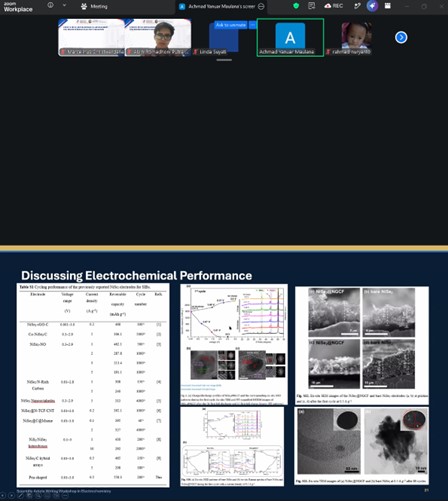
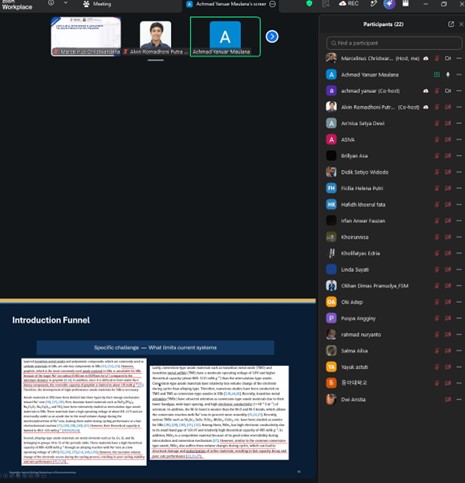
The enthusiasm of the participants was reflected in the active discussion during the question-and-answer session. Topics discussed included manuscript preparation, strengthening research data and scientific arguments, developing international research collaborations, and strategies for responding to the peer-review and evaluation process conducted by scientific journals.
The Scientific Article Writing Workshop in Electrochemistry represents a concrete step toward strengthening the scientific communication skills of researchers at Universitas Diponegoro. The program also reinforces the commitment of the Bioelectrochemistry Research Group and the Electrochemistry Research Cluster of FSM UNDIP to building a productive, innovative, and internationally oriented research ecosystem.
Following the successful implementation of the workshop, participants are expected to apply the knowledge and strategies gained to produce higher-quality scientific articles and further expand the contribution of electrochemistry research from Universitas Diponegoro to the global academic community.